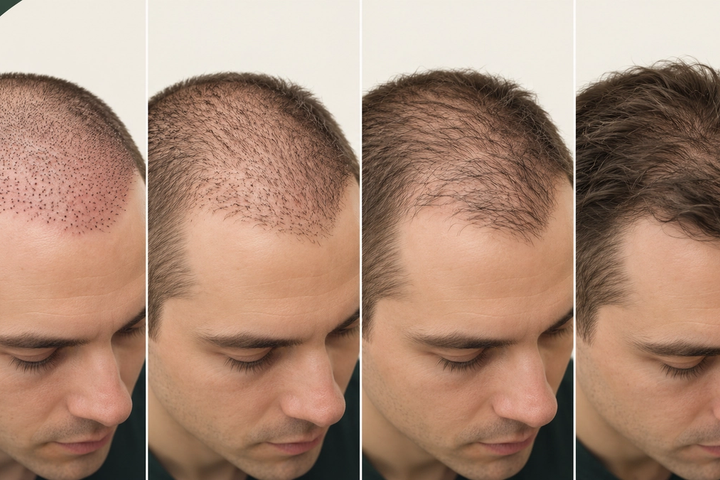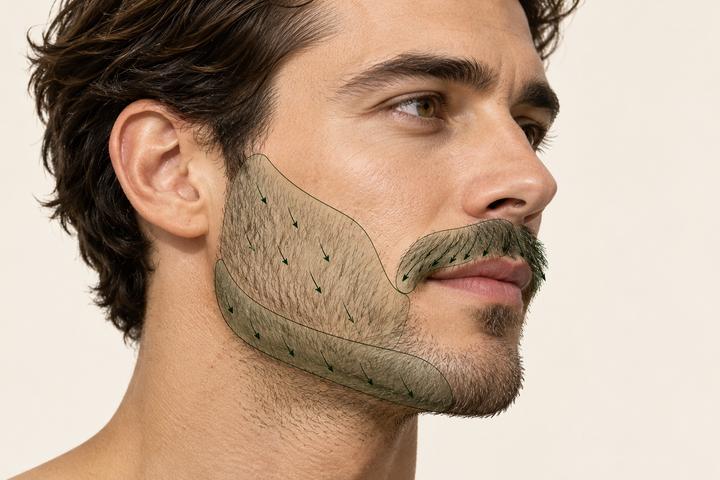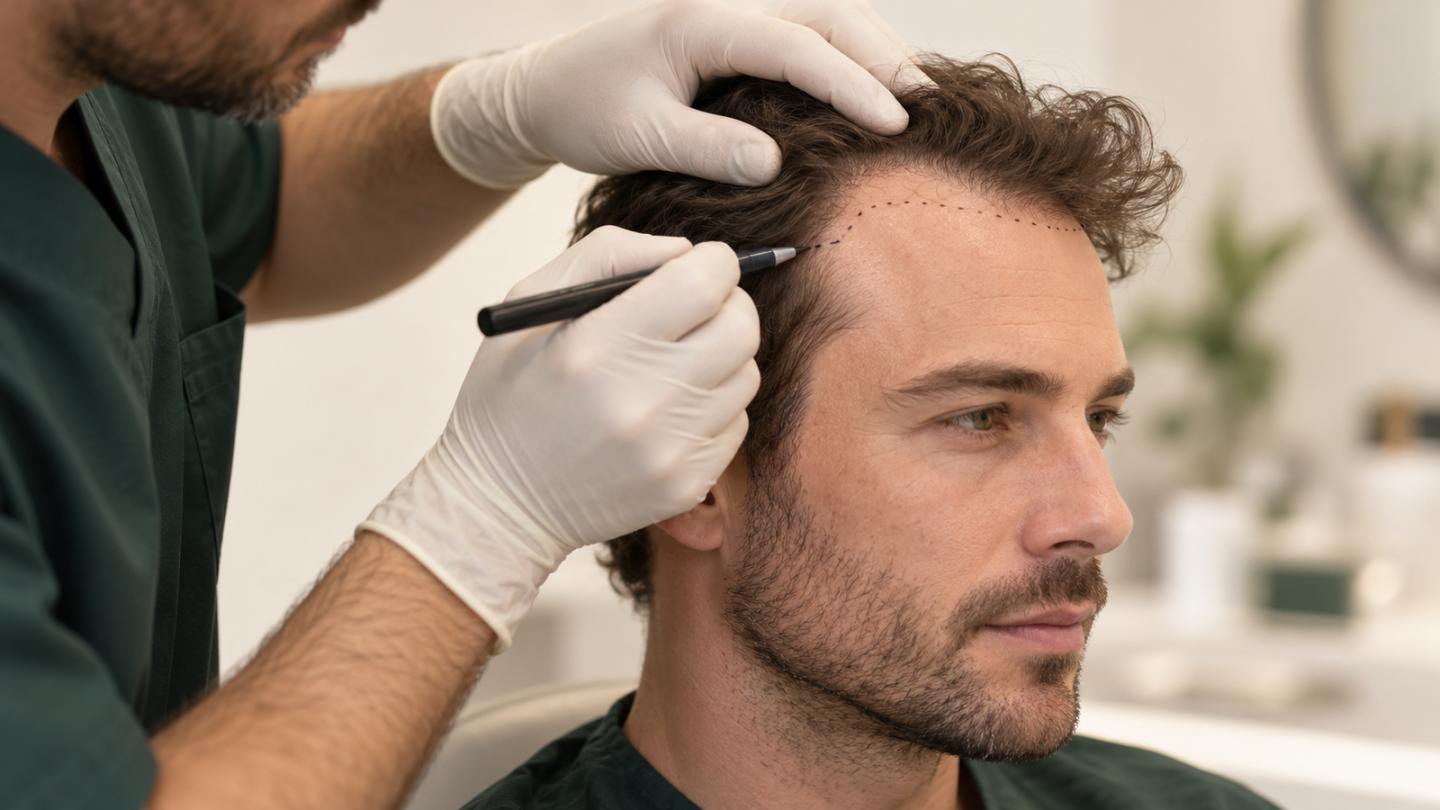
The hairline is the most visible part of many hair transplants, yet naturalness cannot be reduced to one measurement. A line can be technically dense and still look artificial if it is too low, too straight, poorly angled or unsupported behind the front. Design must connect facial proportions with the long-term limits of the donor area.
Modern planning treats the hairline as a transition zone rather than a drawn border. The peer-reviewed state-of-the-art review of hair transplantation describes the procedure as a combination of assessment, design, harvesting and placement—not a single device or number.
Start with the face, not a template
Forehead height, temple shape, brow position, head contour and existing recession differ between people. A copied celebrity line may not fit those proportions or the available donor hair. The design should be viewed upright from the front, side and above because a line that looks acceptable in one camera angle may appear low or asymmetric in another.
Age-appropriate does not mean old-fashioned
A mature line can still frame the face clearly. The question is whether it can remain believable if native hair continues to thin. Very low juvenile shapes consume more grafts and may isolate the transplanted edge later. Ask the clinician to show how the design relates to possible progression and what donor reserve remains.
Micro-irregularity and macro-shape
Natural hairlines are not ruler-straight, but random jaggedness is not automatically natural. Small irregularities should sit within a coherent overall shape. Larger peaks, recessions and temporal transitions must relate to facial structure. The goal is controlled variation that disappears into the whole result rather than a visibly patterned edge.
Single-hair grafts at the front
Follicular units vary in hair count. Carefully selected single-hair units are generally important along the leading edge, while multi-hair units can contribute visual density behind them. Placement should also respect calibre and texture. Ask how grafts will be sorted and how the team prevents obvious multi-hair plugs at the front.
Angle and direction
Hair emerges at changing angles across the frontal scalp and temples. Recipient sites or implantation control should reproduce a flow that can be styled naturally. Incorrectly upright or crossing hairs may draw attention even when growth is good. Direction is therefore part of design approval, not merely a technical detail on the day.
Density and the donor budget
The appearance of density comes from distribution, hair characteristics and contrast as well as graft count. Lowering the line increases the surface area that must be covered. Your graft and donor plan should show what is allocated to the transition zone, central forelock and areas behind, plus what is saved for future needs.
Approve the design carefully
- Review it while sitting upright, with relaxed facial muscles.
- Look from the front, both profiles and above—not only in a mirror selfie.
- Ask why the central height and temple transitions suit your case.
- Discuss existing asymmetry instead of assuming perfect symmetry is natural.
- Photograph the agreed design before the procedure begins.
When a previous hairline needs correction
A low, straight, pluggy or misdirected hairline may require removal, redistribution, camouflage or a combination. Adding more grafts is not always the first answer because donor supply and skin condition may be limiting. Read our guide to hair transplant correction for the staged assessment.
Bring references, but expect a clinical discussion
Reference photographs help communicate preferences, not prescribe a line. A responsible consultation explains what elements can be adapted and what would be unsafe or unsustainable. Use our consultation questions and review the hair transplant approach before signing off a design.
To discuss your own facial proportions and donor limits, request an assessment with clear front, profile, top and donor photographs. This guide cannot design an individual hairline remotely.
Sources and further reading
See Hair Transplantation: State of the Art, Follicular unit extraction — review, and American Academy of Dermatology — hair transplantation.
Frequently asked questions
How low should a transplant hairline be?
There is no universal measurement. The height should fit facial proportions, existing loss, likely progression and the donor supply needed to support the design over time.
Should a natural hairline be perfectly symmetrical?
Usually not. Faces and natural hairlines have some asymmetry. The aim is balanced and intentional design, not a mechanically mirrored shape.
Why are single-hair grafts used at the front?
Single-hair follicular units can create a softer transition at the leading edge. Larger units placed too far forward may look coarse or plug-like.